
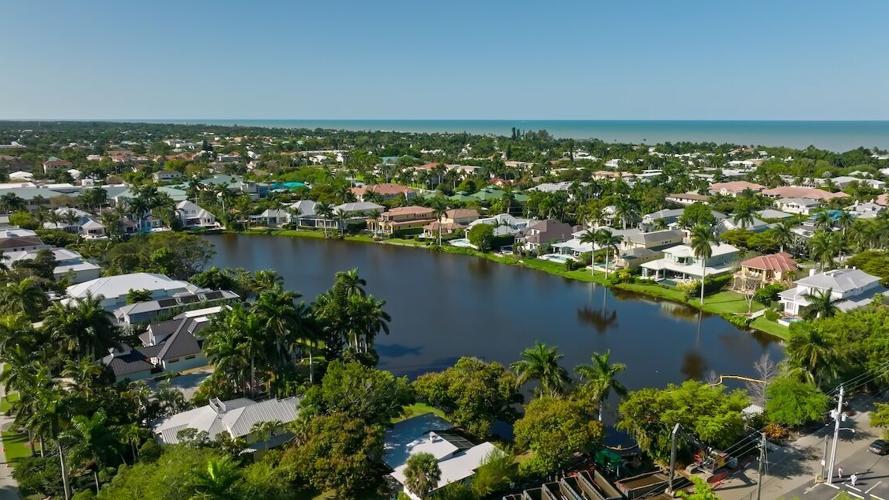




An aerial view shows a residential neighborhood near the Gulf in Collier County, where property market values declined 3.23% in 2026, according to preliminary estimates from the county property appraiser.
Market values for residential and commercial properties throughout Collier County dipped 3.23% from last year, while taxable values rose 3.35% to $170.3 billion, according to preliminary estimates from the property appraiser.
New residential and commercial construction market values decreased more than 25% countywide, while taxable value on new construction dropped 27.5%.
The appraiser’s office reported $217.7 billion in countywide property market value compared with last year’s $224.9 billion — representing the only annual decline in a decade. Market values are the appraiser’s estimate of a property’s just value as of Jan. 1. Properties are reappraised yearly to reflect the economy of a community and the proper market values created by supply and demand for property through buying and selling transactions.
In contrast, taxable values — the assessed value after homestead and other exemptions are applied — increased from $161.4 billion to $166.8 billion year-over-year.
Collier County property appraiser Vickie Downs attributed the slip in market values to a “market that cooled from prior highs, with increased inventory and greater buyer leverage.
“High interest rates continued to affect non-cash buyers, particularly first-time homebuyers,” Downs said. “We do not apply a countywide increase or decrease; values reflect the 2025 market evidence within each residential market area. Some areas declined, while others remained stable or increased. Real estate markets do not move uniformly, and our responsibility is to follow the market evidence.”
The recalibration follows several years of appreciation. In 2022, during the height of pandemic-era relocations, market values skyrocketed more than 40% in Naples and nearly 41.5% countywide.
Downs’ office also reported year-over-year declines in both market and taxable values for new construction. Preliminary estimates place a market value of $3.2 billion for 2026 compared with $4.29 billion in 2025. Taxable value on new construction decreased from just over $4 billion last year to $2.9 billion.
Preliminary market values in Naples dipped 2.93% to $53.4 billion, while taxable value rose 4.26% to $42.7 billion. The city’s market and taxable values on new construction were down by $28.1 million and $28.3 million, respectively. The number of residential properties, including vacant land, condos, single-family homes and co-ops increased by 70 units to 19,592.
Improved commercial property in Naples declined from 485 units in 2025 to 479 units in 2026. Overall commercial and industrial increased by two units.

An aerial view shows Marco Island in Collier County, where property market values declined 2.15% in 2026 while taxable values increased 4.39%, according to preliminary estimates from the county property appraiser.
Property on Marco Island showed a 2.15% decline in market value versus a 4.39% increase in taxable value. Preliminary estimates report the city’s market value at $23.4 billion with a taxable value of $19 billion. New commercial and residential construction account for $290.2 million in market value and $274.9 million in taxable value — a dip from 2025’s respective $359.1 million and $334.3 million. Data shows Marco Island has 20,035 residential properties — down by three units from 2025 — and 351 commercial and industrial properties.
Everglades City was the only municipality reporting a modest 0.69% gain in market value, up to $196 million, while also recording a 2.06% increase in taxable value of $139.2 million. New construction posted a more than threefold increase in market value, from $1.5 million to $5.2 million market value, while taxable value improved 17.3% to $1.8 million. The city has 709 residential properties and 81 commercial and industrial properties, a modest increase of 28 units over the past decade.
The appraiser’s office sent TRIM, or Truth in Millage, notices in August, detailing each property’s market value, assessed value, exemptions and proposed tax rates. Assessed value is the value of a property after applying assessment limitations, such as Save Our Homes for homesteaded property and other applicable assessment caps. Collier County has 230,662 residential properties, of which roughly 110,000 have homestead exemptions.
“An increase in taxable value can generate additional property tax revenue for a taxing authority if the taxing authority does not reduce its millage rate enough to offset the increase in taxable value,” Downs said. “That is essentially the purpose of the TRIM process — to provide taxpayers with information about proposed taxes and allow them to see how changes in value and millage rates affect their taxes.”
With 44% of Collier County’s proposed fiscal year 2027 budget derived from ad valorem taxes, the increase in taxable values is expected to generate about $18.7 million more for countywide taxing districts versus last year and an additional $2.1 million for the unincorporated area general fund based on proposed millage rates, according to Christopher Johnson, division director of corporate financial and management services. There are 24 municipal and dependent taxing districts countywide, including the Pelican Bay Municipal Services Taxing and Benefit Unit, Unincorporated Area General Fund, Immokalee Beautification MSTU and Haldeman Creek Dredging MSTU.
“Property taxes fund programs and services, including but not limited to sheriff, EMS, parks, roads, libraries, stormwater, Domestic Animal Services and environmental protection,” Johnson said of various county departments and divisions.
Downs said the county’s tax roll will be certified in October.
Property taxes received by municipalities will decline substantially if voters approve increasing homestead exemptions during the November elections. Amendment 3 proposes raising the homestead tax exemption for non-school taxes to $150,000 in 2027 and $250,000 in 2028, with the amount indexed to inflation starting in 2029.
(0) comments
Welcome to the discussion.
Log In
Keep it Clean. Please avoid obscene, vulgar, lewd, racist or sexually-oriented language.
PLEASE TURN OFF YOUR CAPS LOCK.
Don't Threaten. Threats of harming another person will not be tolerated.
Be Truthful. Don't knowingly lie about anyone or anything.
Be Nice. No racism, sexism or any sort of -ism that is degrading to another person.
Be Proactive. Use the 'Report' link on each comment to let us know of abusive posts.
Share with Us. We'd love to hear eyewitness accounts, the history behind an article.